Share Sale Or Asset Sale? Key Differences When Buying or Selling a Business.

When buying or selling a business, one of the most important decisions is choosing the structure of the transaction. Two of the most common approaches are share sales and asset sales. While both transfer ownership, the way they work, and the risks and benefits involved can be quite different.
This blog will explore the key differences to help you weight up the pros and cons of both approaches either prior to marketing your business for sale or whilst negotiating the heads of terms for sale to a prospective buyer.
What is a Share Sale?
A share sale occurs when a buyer purchases the seller’s shares in a company, effectively taking ownership of the business itself through the shares. By acquiring the shares, you gain control of the company through voting rights and dividend rights which are attached to the shares. The purchase usually includes the buyer also becoming a director of the company, with the seller resigning their position as director.
A share sale can either be of all the issued share capital in the company or just some of the shares in the company, with the seller retaining either a majority or a minority shareholding. The price being paid for the shares will of course reflect the extent to which all of the shares in the company are being acquired.
Pros of a Share Sale:
- Smooth transition of ownership with minimal disruption to the ongoing business operation.
- Contracts, licenses, leases (in the company’s name) and employees typically remain in place.
Cons of a Share Sale:
- You inherit both known and unknown liabilities.
- Requires extensive due diligence to uncover potential existing risks within the business.
- The seller will pay capital gains tax if there is a ‘gain’ on the value of the shares sold
- The buyer will pay stamp duty on their purchase of the shares
What is an Asset Sale?
An asset sale involves purchasing all or some of the assets of a company such as its goodwill, business name, website, customer list, stock, equipment/machinery, any intellectual property, rather than buying the company itself. In this scenario, the selling company retains ownership of any remaining assets and all of the company’s liabilities.
Pros of an Asset Sale:
- Lower risk of inheriting hidden liabilities.
- Flexibility to acquire only the assets that are necessary for your business.
- The capital gains payable on the profit made from the sale of the asset(s) is a gain in the hands of the company and not the individual shareholders. The calculation of the gain could therefore differ to that for a share sale.
Cons of an Asset Sale:
- Contracts, licenses and permits may not automatically transfer and may require additional paperwork.
- Some assets may need a third party to consent to the transfer and this can create additional work to legally transfer each asset individually.
- The sale of the assets is not a complete exit plan for the shareholders of a company and you would need to consider the mechanism for distributing the proceeds of the sale to the shareholders and the tax implications of that distribution in the shareholder’s hands.
Side-by-Side Comparison
Here’s a quick visual overview of the main differences:
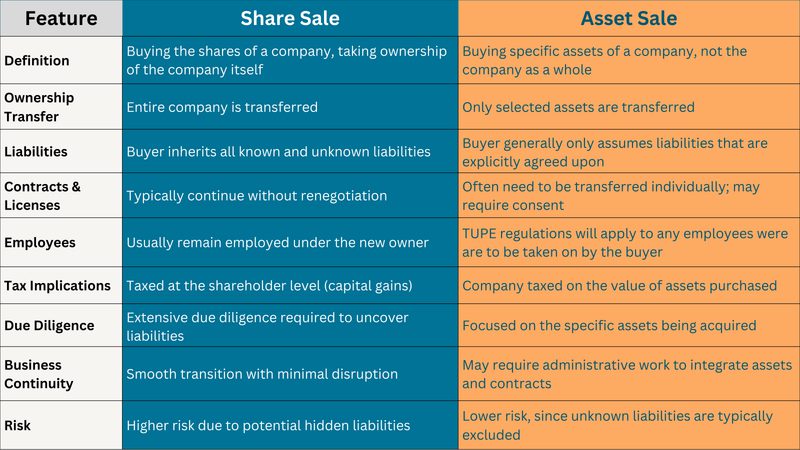
Key Considerations
When deciding which approach to take, keep the following in mind:
- Risk Appetite: If avoiding unknown liabilities is a priority, an asset sale is generally safer.
- Business Continuity: If seamless operation post-sale is important, a share sale may be better.
- Tax Implications: The structure affects both buyer and seller taxes. You must consult a tax professional for specific advice based upon both your own and your business’ individual tax profile.
- Administrative Complexity: Share sales may require more upfront due diligence, while asset sales may require more paperwork post-sale.
Conclusion
Choosing between a share sale and an asset sale is a critical decision that impacts risk, taxes, and the smoothness of the transition. Understanding the differences allows business owners and buyers to align the transaction with their strategic goals.
By carefully weighing the pros and cons, and consulting legal and financial advisors, you can ensure the deal is structured in a way that protects your interests and is the most tax efficient method of extracting value out of your company. Specialist tax advice should also be taken, ideally prior to marketing your business for sale.